Taking the black
A Clash of KingsTaking the black is the formal commitment by which a man enters the Night’s Watch and replaces private ambition with an oath-bound life of service. It is presented not as a ceremonial change of clothing alone, but as a surrender of ordinary social identity: the initiate accepts perpetual watch, military duty, and the renunciation of family, property, succession, and glory. At the same time, the institution’s protection can make the black a last refuge for a defeated or condemned man.
Meaning and Obligations
Taking the black requires the recruit to become a brother of the Night’s Watch. Jon Snow explains that a brother must serve rather than merely bear the title, telling Samwell Tarly that he is already the Old Bear’s steward and must tend his horse, establish his tent, and perform the practical work demanded by the great ranging. The argument rejects the idea that fear or inadequacy excuses a sworn brother from duty: Samwell’s fear is acknowledged as natural, but his oath has still made the obligation real.
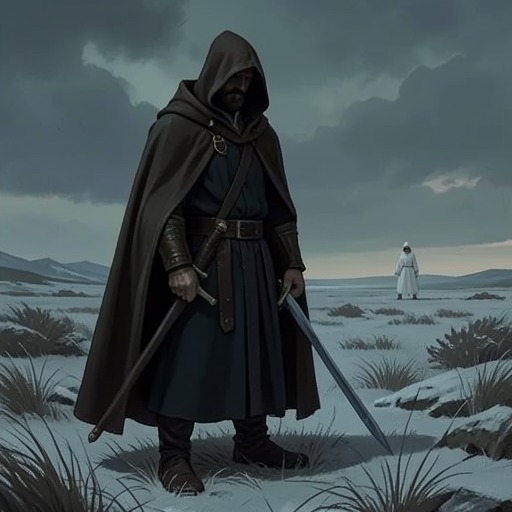
The full form of the Night’s Watch vows gives the commitment its most comprehensive definition. The speaker begins by accepting the night and declaring that the watch will last until death. He promises to take no wife, hold no lands, father no children, wear no crowns, and seek no glory. His life is then defined through images of public protection: sword in the darkness, watcher on the walls, fire against the cold, light bringing the dawn, horn waking sleepers, and shield guarding the realms of men. The vow therefore strips away private inheritance while enlarging the initiate’s imagined responsibility to the whole realm.
A Refuge and a Bargain
The black can also be invoked as a legal and political alternative to execution or captivity. When Theon Greyjoy is trapped in Winterfell and has lost hope, Ser Rodrik Cassel tells him to take the black. The proposal is conditional: Theon must open the gates, lay down his arms, and accept the terms offered by House Stark. Because Ser Rodrik has served House Stark all his life and House Stark has traditionally been friendly toward the Night’s Watch, he believes Theon could be allowed to join rather than face King Robb Stark’s justice.
This offer reveals the double nature of the institution. Taking the black is an irreversible renunciation, but it may also preserve the life of a man who has no ordinary future left. For Theon, the choice stands between surrender and a distant, austere form of survival. The fact that he lowers his bow while considering the proposal shows that the black retains force even when presented by an enemy: it is not freedom, but it is a recognized path out of immediate destruction.
The Night’s Watch in a Violent World
The vow’s severity is sharpened by the conditions surrounding the Watch. The brothers face fear, loss, and supernatural danger beyond the Wall, while the kingdom’s wars produce prisoners, deserters, starving civilians, and men drawn from the dungeons or streets. Yoren recruits men and boys from King’s Landing for the Watch, warning Arya Stark, disguised as Arry, that the company is dangerous and that many of its members might betray her for a pardon or money. The Watch thus appears both as an ancient defense against external threats and as an institution forced to accept damaged, desperate, or morally compromised recruits.
Its moral limits are also made explicit. When Jon objects to Craster’s brutality, Jeor Mormont tells him that Craster is not subject to the Watch’s laws because he has sworn no vows to it. The Watch cannot set the entire world right, Mormont insists; it has other wars to fight. Taking the black therefore imposes a demanding code without granting unlimited authority. A brother may be required to endure injustices outside the Watch’s jurisdiction while preserving strength for the threats the order considers its central purpose.
Symbolic Renewal and Finality
The language of taking the black is closely connected to death and rebirth. During a ceremony performed by Aeron Greyjoy, seawater is poured over Theon’s head while Aeron calls on the Drowned God to let him be born again from the sea. Theon answers with the repeated formula, "What is dead may never die," a religious expression of renewed identity. Although this is not the Night’s Watch ceremony itself, it provides a striking parallel: both rites demand that a former self be left behind and that the initiate submit to a larger order.
The Night’s Watch version is more austere and final. Its promises are spoken beneath the rising moon while Ghost listens and the mountains bear witness; afterward, Jon Snow holds the words in his mind and prays for the strength to die bravely. The surrounding circumstances make the oath more than symbolic. The horses are nearing exhaustion, Qhorin Halfhand’s mount may not last another day, and the fire is burning low. Qhorin’s warning that if the Wall ever falls, all the fires will go out turns the vows into a compact made under the shadow of extinction.
Narrative Significance
Taking the black establishes a central contrast between personal desire and collective duty. The oath forbids the ordinary rewards that define aristocratic life, precisely the rewards pursued by kings, heirs, and conquerors elsewhere in the story. A crown, a house, a marriage, and children are not merely unavailable to the sworn brother; they are named as things he must actively renounce. The black consequently transforms service into an identity that competes with bloodline and political allegiance.
Yet the institution is never presented as pure or effortless. Its members include frightened recruits and men gathered from criminal or impoverished circumstances, while its commanders must choose between intervening in every injustice and preserving the order for its larger war. The concept’s power lies in that tension. Taking the black is simultaneously punishment, refuge, initiation, and sacrifice: a way to lose one life while accepting another whose meaning depends on standing watch until death.